
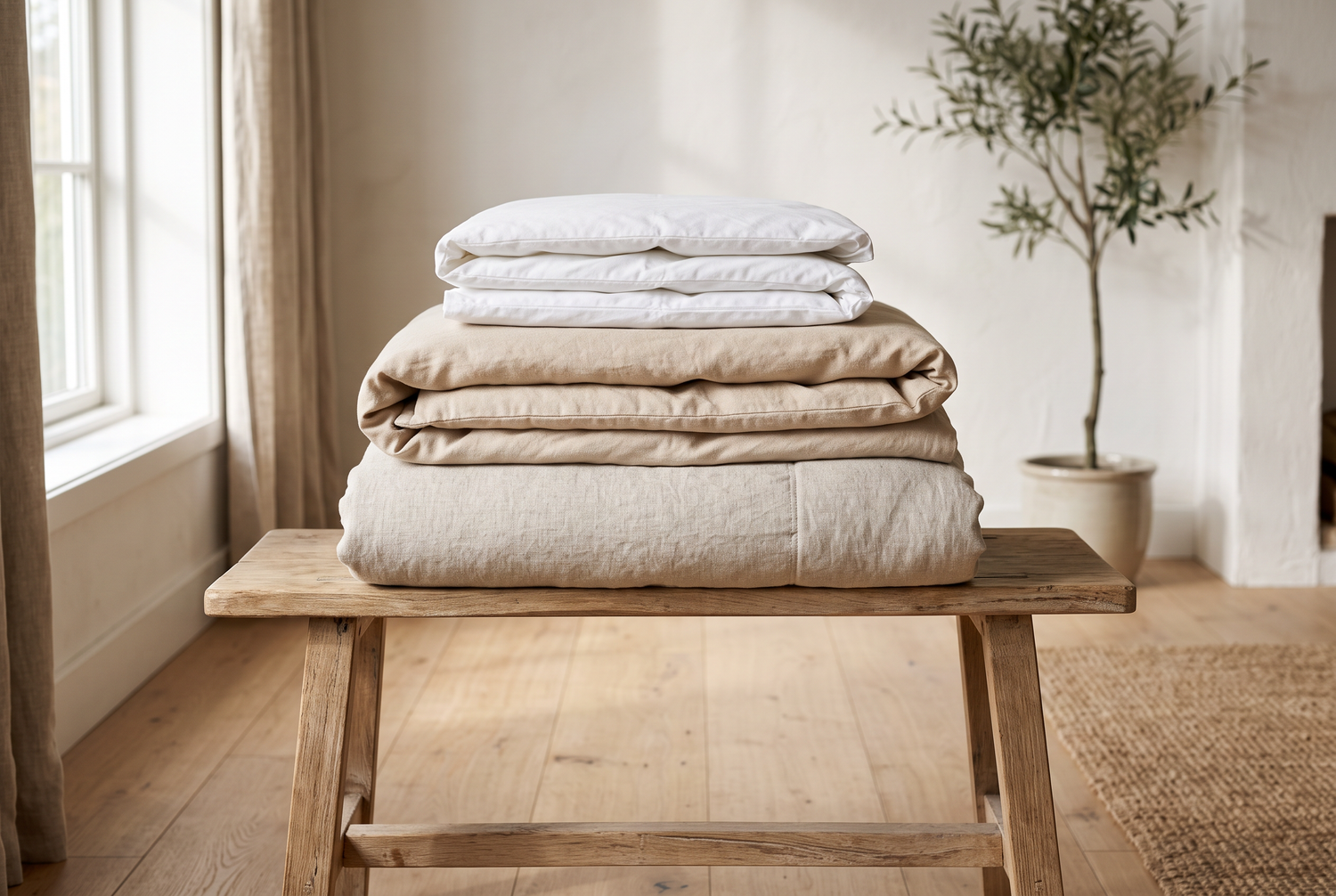
Anyone buying bed linen in Switzerland will sooner or later come across a detail that does not exist in neighboring countries: our duvets are larger. While in Germany the standard size is 135 × 200 cm, here in Switzerland 160 × 210 cm is considered a single duvet – meaning it is 25 cm wider and 10 cm longer. This is no coincidence, but a long-standing tradition. And it has tangible consequences: a duvet cover ordered online from the German range simply won't fit. In addition, the choice of duvet size determines whether cold air penetrates at the sides at night or whether you and your partner fight over the duvet. This guide lists all common Swiss sizes and explains which one fits which bed.
The short answer: The Swiss standard size for a single duvet is 160 × 210 cm. For double beds, there are two options: either two single duvets measuring 160 × 210 cm each, or one large duvet measuring 200 × 210 cm or 240 × 240 cm. The rule of thumb is: the duvet should be at least 30 to 40 cm wider than the person sleeping under it, and at least 20 cm longer than their body height. For people over 185 cm, an extra length of 240 cm is recommended. Important: duvet covers from German retailers usually do not fit.
- Swiss standard single duvet: 160 × 210 cm – significantly larger than the German standard of 135 × 200 cm.
- Couple duvet: 200 × 210 cm or the generous 240 × 240 cm.
- Extra length 160 × 240 cm for people from approximately 185 cm tall.
- Children's duvets measure 100 × 150 cm, baby duvets 80 × 120 cm.
- Always buy duvet covers in Swiss sizes – German sizes do not fit.
Why Swiss duvets are larger
The explanation lies in sleeping culture. In Switzerland, it is common for each person to have their own generously sized duvet – even in a double bed. This practice originates from the Alpine region and has a practical background: if you have your own duvet, you don't pull it away from your partner at night and can regulate your own thermal insulation independently. For a single duvet to fulfill this task, it must be wider than the pure body outline. A width of 160 cm allows for an overhang of about 40 cm on both sides – enough to curl up without creating drafts.
The length of 210 cm follows the same logic. For a body height of 175 cm, there is a reserve of 35 cm that can be tucked in at the foot end. Germany and Austria historically opted for the narrower 135 × 200 cm, partly for cost reasons. This explains why inexpensive bed linen sets from online retailers often do not fit.
Practical consequence: when buying duvet covers, always pay attention to the "Swiss size" indication or the specific dimensions. A 135 × 200 cm cover simply won't fit over a 160 × 210 cm duvet – conversely, a Swiss cover will sag over a German duvet and constantly slip off.
All common Swiss duvet sizes at a glance
| Size (cm) | Description | Suitable for |
|---|---|---|
| 80 × 120 | Baby duvet | Crib from approx. 1 year |
| 100 × 150 | Children's duvet | Junior bed, children's bed up to approx. 8 years |
| 160 × 210 | Swiss Standard | Single bed 90–120 cm, one half of a double bed |
| 160 × 240 | Extra length | People from approx. 185 cm |
| 200 × 210 | Couple duvet | Double bed 160 cm width |
| 240 × 240 | Large couple duvet | Double bed 180–200 cm width |
Not every provider carries all formats. Especially 160 × 240 cm and 240 × 240 cm are special sizes, for which the selection of covers is more limited. If you opt for an extra length, you should order two to three covers at the same time – otherwise, buying more later will turn into a search mission.

Two single duvets or one large one – which is better?
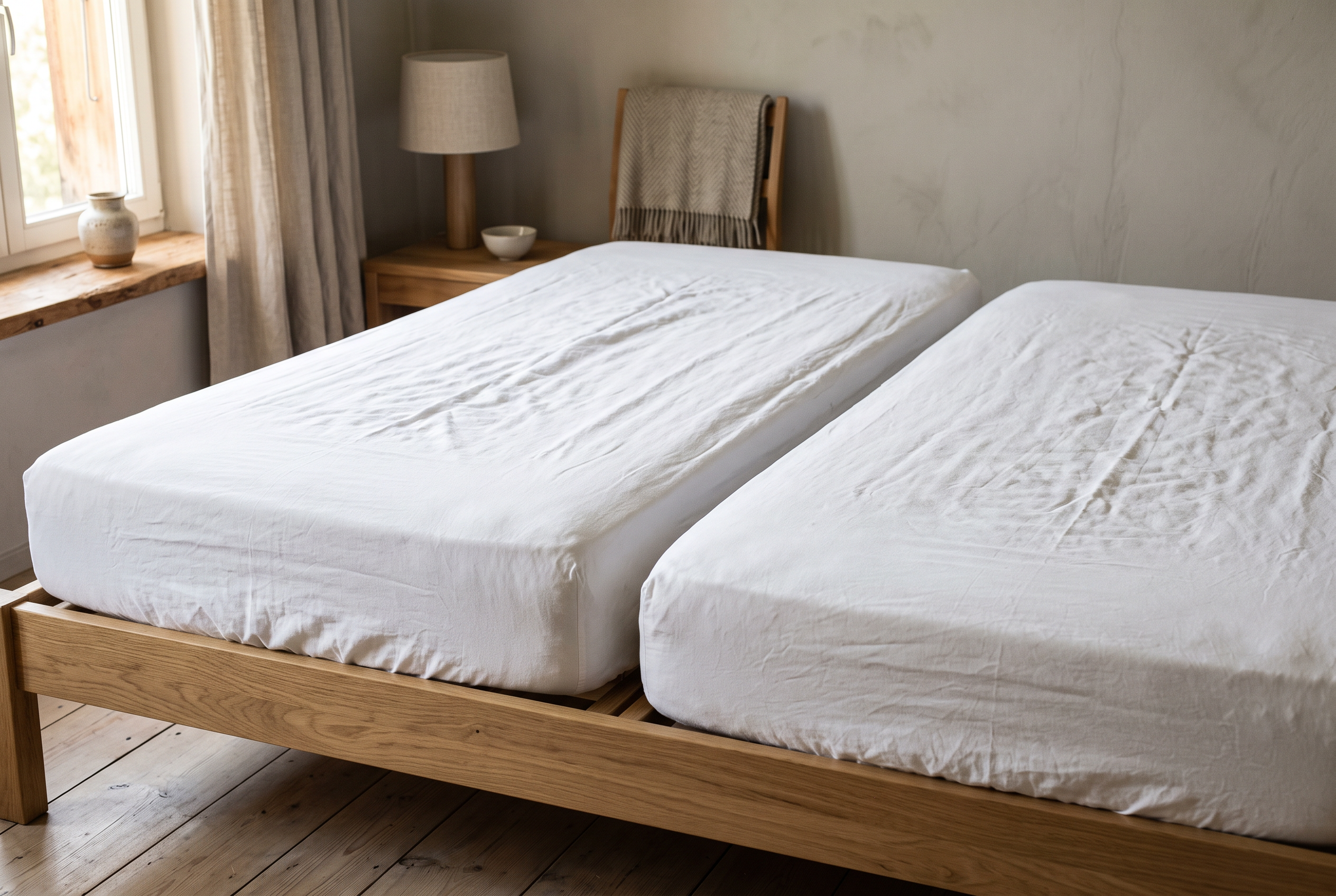
Both options have their merits. Two single duvets measuring 160 × 210 cm in a double bed are the classic Swiss solution. The advantage: each person regulates their own warmth. If you sweat at night, you can choose a light summer duvet, while your partner sleeps under a warm winter duvet. The problem of pulling the covers away from each other at night is also completely eliminated. And two smaller duvets fit better in the washing machine than one large one.
A large couple's duvet measuring 200 × 210 cm or 240 × 240 cm, on the other hand, appears visually calmer and makes the bed a single unit. Those who sleep close together often find the dividing line between two duvets disturbing. The disadvantage is obvious: it becomes difficult if there are different warmth requirements. In addition, 240 × 240 cm does not fit into every household washing machine – check the drum volume beforehand; it should be at least 8 kg.
A pragmatic middle ground: two single duvets, but a single large duvet cover with two compartments. Such models exist, but they are rare and expensive. In practice, two separate duvets are usually better – more on this in the article about duvets for summer and winter.
The right size according to body height and bed
Two rules of thumb help with selection. First, the length: the duvet should be at least 20 cm longer than the person. For a body height of 175 cm, 210 cm is comfortably sufficient. From about 185 cm, it becomes tight – feet hit the end or shoulders are exposed. Then 240 cm is the right choice.
Second, the width: allow for at least 30 to 40 cm overhang per side. A standard duvet with a width of 160 cm generously covers a person with a shoulder width of 45 cm. If you toss and turn a lot or like to wrap yourself up, you should plan more generously. On a 90 cm wide single bed, a 160 cm duvet initially seems oversized – but when lying down, it becomes clear that precisely this overhang keeps drafts away.
For bed size: On a bed measuring 160 × 200 cm, two single duvets or a 200 × 210 cm couple duvet work well. On a bed measuring 180 × 200 cm, a couple duvet needs to be at least 240 cm wide, otherwise it won't hang over the edges.
Common mistakes when buying duvets
Mistake 1: Ordering covers in German sizes. The most common and annoying mistake. A 135 × 200 cm cover does not fit over a 160 × 210 cm duvet. When ordering online, always check the specific centimeter measurements, not just descriptions like "single bed."
Mistake 2: Only thinking about mattress width. The duvet is sized for the person, not the bed. On a narrow single bed of 90 cm, a 160 cm wide duvet is still correct – the overhang hangs down the sides and keeps you warm.
Mistake 3: Ignoring the filling quantity. Two duvets of the same size can differ greatly in thermal performance. Pay attention to the thermal class or filling weight. A light summer version of 160 × 210 cm often weighs only 400 to 600 g, a winter duvet 1200 to 1800 g.
Mistake 4: Not checking washability. A 240 × 240 cm duvet requires a washing machine with at least 8 kg drum capacity. Otherwise, the filling will not be rinsed clean and will clump. For how often which textiles should be washed, see changing bed linen.
Mistake 5: Equating summer and winter. If you use the same duvet all year round, you'll sweat in July and freeze in January. Two duvets per person are the norm in Switzerland – or a combi duvet made of two attachable layers.

Duvet, mattress, and sleeping climate are interconnected
The duvet size alone does not determine a good sleeping climate. It is one component alongside room temperature, mattress material, and bedding. A bedroom temperature of 16 to 19 °C is a guideline; if it gets warmer, even the lightest duvet only helps to a limited extent. Read more about this in the article on the ideal sleeping temperature.
Equally important is how well the mattress wicks away moisture. The body releases around 0.2 to 0.5 liters of fluid per night, mostly as water vapor. Some of this travels downwards into the mattress. Open-pored materials transport this moisture away, while closed ones trap it. If you sweat at night despite a light duvet, you should therefore look not only at the top but also at the bottom. Information on this can be found under causes of night sweats.
Get CHF 25 discount
Subscribe to the newsletter and receive a one-time CHF 25 discount. ✓ 200 nights trial sleep ✓ 10 years warranty
Frequently asked questions about duvet sizes in Switzerland
What is the standard duvet size in Switzerland?
The Swiss standard size for a single duvet is 160 × 210 cm. This makes it significantly more generously cut than the German standard of 135 × 200 cm. For double beds, the sizes 200 × 210 cm and 240 × 240 cm are also available.
Do German duvet covers fit Swiss duvets?
No. A German cover measuring 135 × 200 cm is both too narrow and too short for a Swiss duvet measuring 160 × 210 cm. When buying, always pay attention to the specific centimeter dimensions and not just to designations like single bed or double bed.
From what body height do I need an extra-long duvet?
As a guideline, the duvet should be at least 20 cm longer than the person. From about 185 cm body height, the standard size of 210 cm becomes tight – then the extra length of 240 cm is recommended so that neither feet nor shoulders are exposed.
Two single duvets or one large duvet for a double bed?
Two single duvets measuring 160 × 210 cm each allow for individual temperature regulation and prevent nightly tug-of-war. A large duvet measuring 200 × 210 cm or 240 × 240 cm appears visually calmer, but only works well if both people have similar warmth requirements.
What duvet size is suitable for children?
For children's beds, 100 × 150 cm is the common size, and for cribs from about one year old, 80 × 120 cm. In a baby cot under one year of age, duvets and pillows are generally omitted, and a sleeping bag is used instead.
Can I wash a 240 × 240 cm duvet at home?
Only with a washing machine with at least 8 kg drum volume. In smaller machines, the filling will not be rinsed clean and can clump. Additionally, check the manufacturer's instructions for washing temperature and drying.








Leave a comment
This site is protected by hCaptcha and the hCaptcha Privacy Policy and Terms of Service apply.