
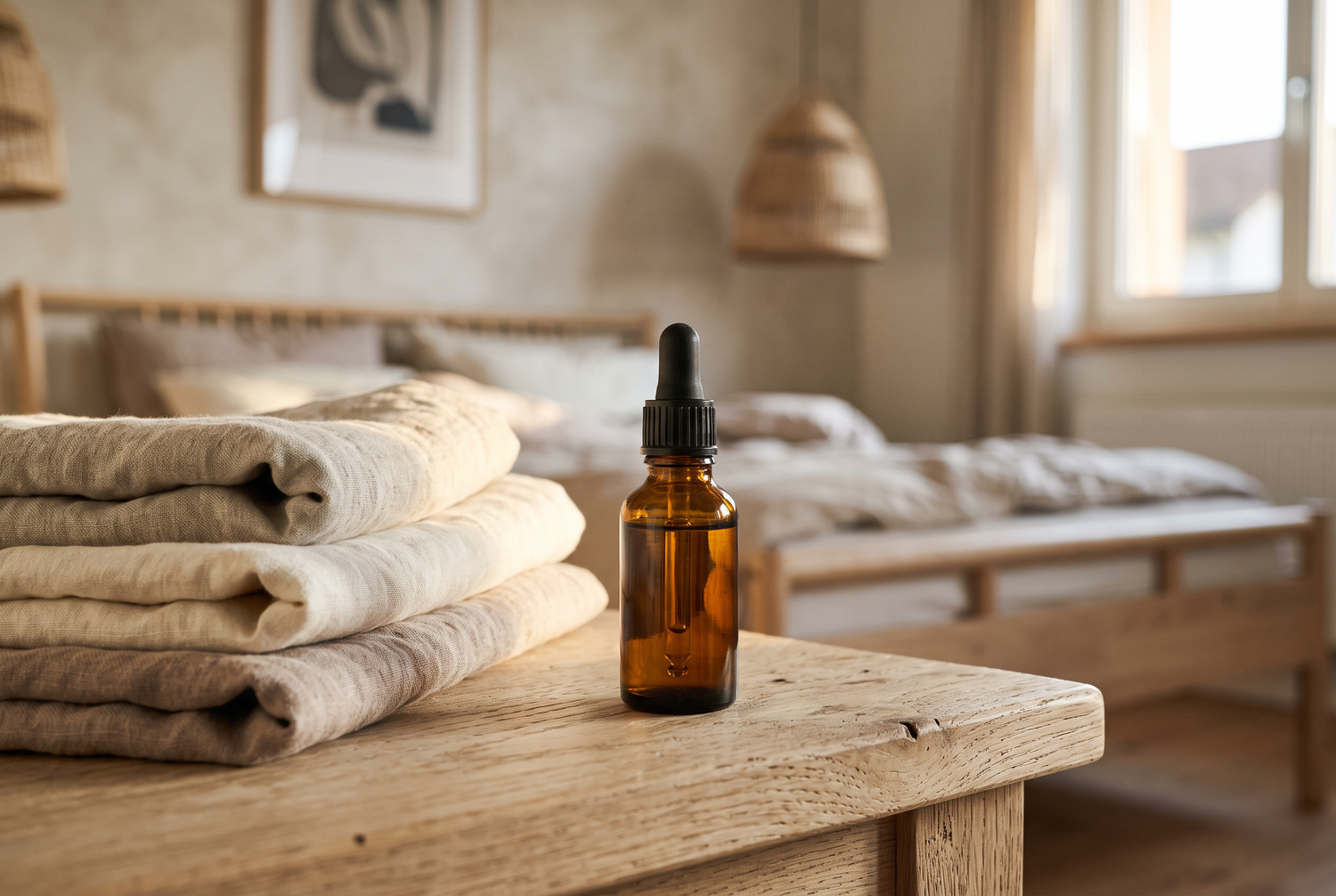
In just a few years, CBD has gone from a niche product to a shelf-filler: oils, capsules, drops, gummy bears – and "sleep" or "relaxation" is almost always on the packaging. The contrast between marketing promises and the scientific data is rarely as stark as with CBD. Cannabidiol is a serious substance with proven effects – but primarily in an area that has little to do with normal falling and staying asleep, namely in certain severe forms of epilepsy at high, prescription-only dosages. For everyday sleep use, the evidence is thinner than the market suggests. This article clarifies what has been researched, what legal regulations apply in Switzerland, what you should look for in products – and where the limits lie.
The short answer: There is currently no robust evidence that CBD reliably improves sleep quality in healthy people. The existing studies are mostly small, short, and methodologically limited; where effects are found, they usually concern anxiety and inner restlessness – and better sleep is then more a consequence of this than a direct effect. Dosages, product quality, and bioavailability also differ greatly. In Switzerland, CBD products with less than 1 percent THC are marketable but not approved as medicines, which means no therapeutic claims can be made. Anyone trying CBD should do so with realistic expectations, good product choice, and medical consultation if they are taking existing medication.
- CBD is not psychoactive in the sense of causing intoxication – this clearly distinguishes it from THC.
- In Switzerland, the 1 percent THC limit applies; below this, products are marketable but not approved medicines.
- Studies on sleep are mostly small and short; proven effects relate more to anxiety than directly to sleep.
- Relevant interactions occur via liver enzymes – always consult a doctor if you are on existing medication.
- Be cautious with products without an analysis certificate: market surveys have repeatedly found differing CBD content.
What CBD is – and what it is not
Cannabidiol is one of over a hundred cannabinoids found in the cannabis plant. Unlike tetrahydrocannabinol, or THC, it barely binds to the cannabinoid receptor CB1 in the brain and therefore does not produce an intoxicating effect. Its mechanism of action is more complex and not yet fully understood: influences on serotonin receptors, on the breakdown of the body's own endocannabinoids, and on various ion channels are discussed.
The greatest risk of confusion lies in equating it with cannabis. Concluding from anecdotal reports about the sleep-promoting effect of THC-containing cannabis to CBD is a misconception: the two substances behave differently pharmacologically. Interestingly, in some studies, CBD at low doses even has a slightly stimulating effect, while at higher doses it tends to be more calming – a so-called biphasic effect, which further complicates the interpretation of studies.
It is also important to distinguish it from medication. There are approved CBD-containing medications for narrowly defined indications, at dosages far exceeding what is found in over-the-counter oils. A product from the shelf is not comparable.
The research situation soberly considered
Reviewing the literature reveals three categories of findings. First: studies on anxiety and inner restlessness, in which CBD shows moderate effects at dosages of approximately 25 milligrams daily. Second: small sleep studies with mixed results – some report improved subjective sleep quality, while others find no difference to placebo. Third: studies on specific groups such as people with Parkinson's-associated REM sleep behavior disorder or chronic pain, whose results cannot be extrapolated to healthy sleepers.
Methodologically, three weaknesses repeatedly stand out. The sample sizes are usually small, often under 100 people. The observation periods are short – often four to eight weeks, which says little for a substance that is intended for long-term use. And the dosages used vary between 25 and several hundred milligrams, making comparisons almost impossible.
The most honest summary is therefore: CBD could indirectly help with falling asleep by reducing tension, especially in people whose sleep problem is largely driven by rumination and restlessness. A direct, reliable sleep effect has not been proven. Anyone who wants to address their sleep problem systematically will find the method with much better data in the article on CBT-I.

Legal situation and product quality in Switzerland
In Switzerland, a THC limit of 1 percent applies to hemp products – higher than in many EU countries, where usually 0.2 or 0.3 percent applies. Products below this limit do not fall under the Narcotics Act and are marketable. However, they are not approved medicines: statements about healing, alleviation, or prevention of diseases are not permitted for such products, which is why packaging often features vague formulations.
The quality issue is practically significant. Market surveys in several countries have repeatedly found considerable discrepancies between declared and actual CBD content, and in individual cases, THC levels above the permitted limit. Therefore, always look for an up-to-date analysis certificate from an independent laboratory, stating CBD and THC content, as well as pesticides, solvent residues, and heavy metals. Reputable providers will make this available upon request or by batch number.
Another point concerns travel and profession. The legal situation differs significantly internationally; import into some countries is prohibited. And with full-spectrum products containing trace amounts of THC, positive results in sensitive drug tests cannot be ruled out – relevant for professions with regular controls.
Forms of application and dosage
| Form | Onset of action | Note |
|---|---|---|
| Oil under the tongue | 15–45 minutes | Hold for 60–90 sec; most common form |
| Capsules | 60–120 minutes | Precisely dosable, but slower onset of action |
| Edibles, gummies | 60–120 minutes | Often low dose, frequently high in sugar |
| Full spectrum | – | Contains trace amounts of THC; relevant for drug tests |
| Broad spectrum | – | THC-free processed, otherwise similar |
| Isolate | – | Pure CBD, most calculable |
There is no established recommendation for dosing for sleep application. In practice, one usually starts low and gradually increases, observing for several days at a time. Take the preparation one to two hours before your planned bedtime so that the effect occurs within the correct window. And calculate the actual CBD content: a "10 percent oil" contains about 5 milligrams per drop – an indication often missing from labels.
Side effects and interactions
CBD is considered to be relatively well tolerated at the dosages studied, but it is not free of side effects. Reported side effects include next-day fatigue, diarrhea, appetite changes, dry mouth, and, at higher doses, changes in liver values. The latter is why medical supervision is advisable for long-term use of higher doses.
The most clinically important aspect is interactions. CBD inhibits certain liver enzymes of the cytochrome P450 system, which metabolize a large proportion of common medications – including blood thinners, antiepileptics, certain antidepressants, and immunosuppressants. This can lead to higher effective levels of the respective medication. Therefore, individuals who regularly take medication should not start CBD without medical or pharmaceutical consultation. This is not a formal note, but the most practically relevant point of this article.
CBD should not be used by pregnant and breastfeeding women, nor by children and adolescents outside of medically prescribed therapies. Caution is also advised in cases of known liver diseases.
Common mistakes
Mistake 1: CBD as a substitute for root cause analysis. If you've had sleep problems for months, you should first determine whether it's a problem falling asleep or staying asleep and what factors are perpetuating it – see the article on trouble falling asleep and staying asleep.
Mistake 2: Judging after two evenings. Sleep naturally fluctuates significantly. A meaningful assessment requires at least two weeks with a log – otherwise, you're evaluating randomness.
Mistake 3: Not paying enough attention to the product. Without an analysis certificate, you don't know how much CBD is in it, nor if there are any residues. The price per milligram of CBD, not per bottle, is the relevant comparison metric.
Mistake 4: Combining with alcohol. Both can have a sedative effect; the combination is not well studied and makes assessing your own reaction impossible. How much alcohol alone changes the night is covered in the article on alcohol and sleep quality.
Mistake 5: Skipping the basics. Room temperature, light, consistent wake-up time, and a suitable sleeping surface are more reliable than any dietary supplement. The systematic approach to this is in the article on sleep hygiene.

If you still want to try it
Preparation: Clarify existing medication with your doctor or pharmacist. Choose a product with an up-to-date analysis certificate and calculate the milligram content per drop.
Week 0: Keep a sleep diary for one week without any changes – time to fall asleep, wake-up periods, recovery on a scale of 1 to 5. Without this baseline, no assessment is possible.
Week 1 to 2: Start with a low dose, one to two hours before your planned bedtime, at the same time each day. Do not change anything else – no new mattress, no new evening routine, otherwise you won't know what worked in the end.
Week 3 to 4: If there is no effect, adjust the dose moderately, observe for at least two more weeks. If you feel tired the next day, reduce the dose or take it earlier.
Evaluation: Compare the average values with the baseline. If no noticeable improvement occurs after four to six weeks, CBD is probably not the right path for you – then investing in the basics is much more worthwhile.
Get CHF 25 discount
Subscribe to our newsletter and receive a one-time CHF 25 discount. ✓ 200 nights trial sleep ✓ 10 years warranty
Frequently asked questions about CBD and sleep
Does CBD demonstrably help with falling asleep?
A direct, reliable sleep effect has not been proven. The available studies are mostly small, short, and methodologically limited, and where effects are found, they more often concern anxiety and inner restlessness than sleep itself. An indirect benefit is conceivable for people whose sleep problem is strongly driven by tension and rumination.
Does CBD make you high or addicted?
No. Cannabidiol hardly binds to the cannabinoid receptor CB1 in the brain and therefore does not produce an intoxicating effect – this clearly distinguishes it from THC. An addiction potential in the sense of classic addictive substances is not described according to current knowledge. However, this does not mean that the substance is free of side effects or interactions.
Is CBD legal in Switzerland?
Products with less than 1 percent THC do not fall under the Narcotics Act in Switzerland and are marketable. However, they are not approved medicines, which is why no claims about healing or alleviating diseases may be made. Caution is advised when travelling abroad, as the legal situation varies significantly internationally.
What interactions are important?
CBD inhibits certain liver enzymes of the cytochrome P450 system, which metabolize many common medications – including blood thinners, antiepileptics, certain antidepressants, and immunosuppressants. This can lead to an increase in their effective levels. Anyone who regularly takes medication should only use CBD after consulting a doctor or pharmacist.
What should I look for when buying?
Look for an up-to-date analysis certificate from an independent laboratory, stating CBD and THC content, as well as pesticides, solvent residues, and heavy metals. Market surveys have repeatedly found considerable discrepancies between declared and actual content. Compare the price per milligram of CBD, not per bottle.
How long should I test CBD before judging?
At least four to six weeks, with a baseline of one week of sleep journaling without any changes beforehand. Sleep naturally fluctuates greatly, so two or three evenings say nothing. Do not change anything else simultaneously during the test, otherwise the effect cannot be attributed.
This article is for general information purposes only and does not replace medical advice.








Leave a comment
This site is protected by hCaptcha and the hCaptcha Privacy Policy and Terms of Service apply.