
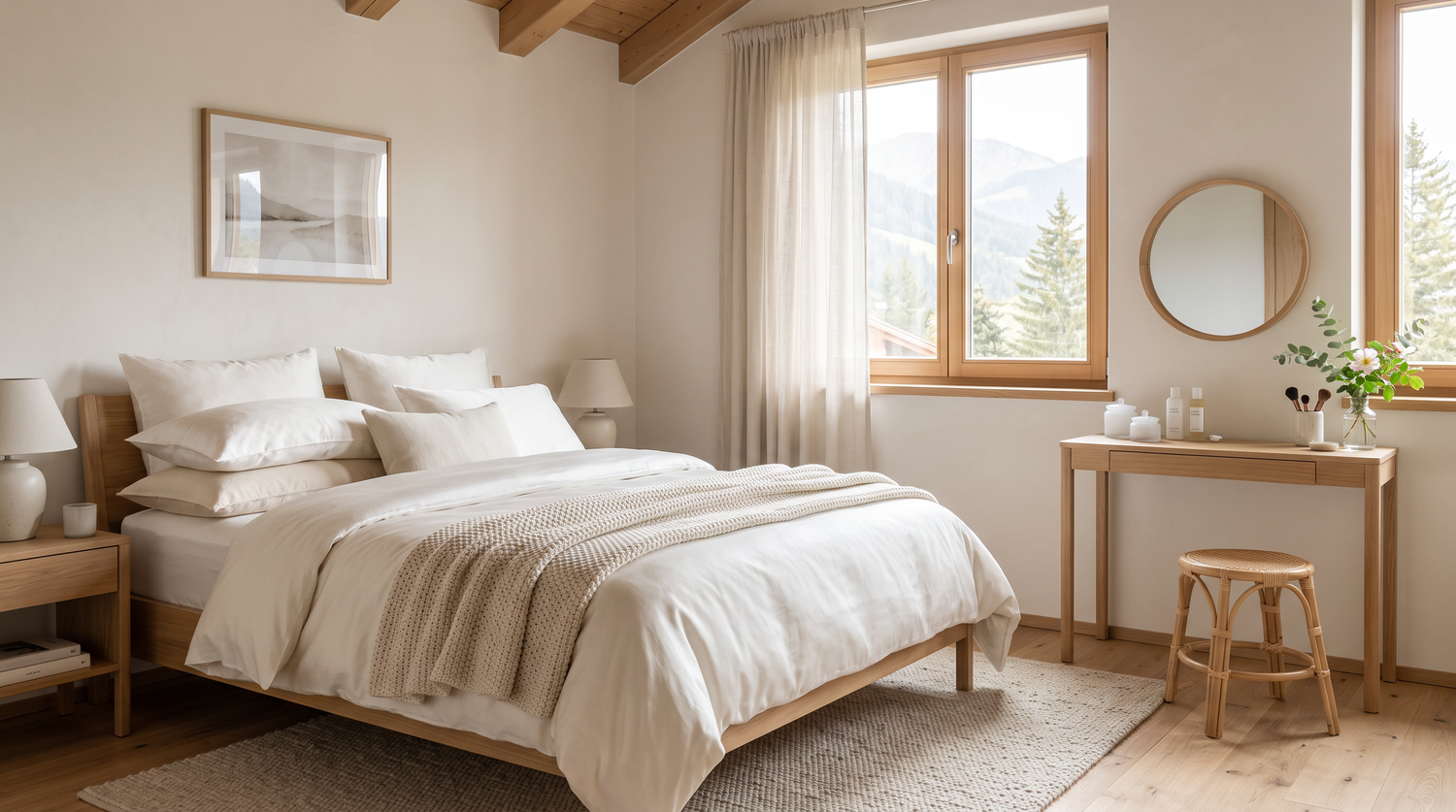
"Beauty sleep" sounds like an old wives' tale – but it's surprisingly well-documented. While we sleep, our skin switches into repair mode: cell division, collagen formation, and blood circulation peak at night. Those who consistently get too little or poor sleep literally see it in the mirror: a dull complexion, dark circles, and earlier wrinkle formation. In this article, we show what truly happens to your body during beauty sleep – and how you can make your nights your best skincare routine.
The short answer: Beauty sleep is real. At night, especially during deep sleep, the body releases growth hormones that stimulate cell renewal and collagen production in the skin. At the same time, the stress hormone cortisol, which breaks down collagen, decreases. Even a single poor night of sleep makes the skin measurably duller and more tired – regular 7–9 hours of good sleep are therefore the most effective and affordable anti-aging measure of all.
- At night, skin cell division and collagen formation are in full swing – controlled by growth hormones during deep sleep.
- Sleep deprivation increases cortisol, promotes inflammation, and visibly accelerates skin aging.
- Dark circles, a dull complexion, and drooping mouth corners are demonstrably perceived by others.
- Sleeping position, pillow, bed climate, and a pressure-relieving mattress influence how refreshed skin and face look in the morning.
What happens to your skin at night
The skin follows its own daily rhythm. During the day, it's in defense mode: it protects against UV radiation, dirt, and free radicals. At night, it switches to regeneration mode – and this is closely linked to our sleep stages.
Deep sleep: the hour of growth hormones
Deep sleep dominates the first hours of the night. Now, the pituitary gland releases growth hormone (HGH) – the most important trigger for cell repair and collagen formation. Collagen is the skin's scaffold: it keeps it firm and elastic. Shortening deep sleep literally throttles nocturnal collagen production.
Cell division on night shift
The division rate of skin cells is many times higher at night than at noon – peaking around one in the morning. At the same time, blood circulation to the skin increases, nutrients are supplied, and waste products are removed. That's why active ingredients from evening care products work better than during the day: the skin is more receptive, but also loses more moisture at night.
Cortisol: the collagen killer
Sleep deprivation increases cortisol levels. Chronically elevated cortisol breaks down collagen, weakens the skin barrier, and promotes inflammation – one reason why acne, neurodermatitis, or psoriasis often worsen during stressful, sleep-deprived periods.

Visible consequences: What sleep deprivation does to your face
Swedish researchers showed in much-noticed studies: people who are sleep-deprived are perceived by others as more tired, less attractive, and even less healthy – based on photos, without any prior knowledge. Typical features after poor nights are drooping eyelids, red eyes, darker dark circles, paler skin, and more fine lines.
| Feature | After sleep deprivation | After restful sleep |
|---|---|---|
| Complexion | Dull, pale, uneven | Rosy and well-circulated |
| Eye area | Dark circles, swelling, drooping eyelids | Awake, de-puffed |
| Skin barrier | Weakened, more moisture loss | Stable, well-hydrated |
| Collagen production | Reduced, cortisol breaks down collagen | Active thanks to growth hormone |
| Skin imperfections | More inflammation and irritation | Faster healing |
How to optimize your beauty sleep
1. Prioritize sleep duration and regularity
7–9 hours per night, ideally at consistent times – that's the foundation. How much sleep you individually need can be found in our guide How much sleep is enough?.
2. Cool, dark, quiet
A cool bedroom around 18 degrees Celsius promotes deep sleep and prevents nocturnal sweating, which dehydrates the skin. More on this in the article on ideal sleeping temperature. Darkness is also important for the hormone melatonin, which also acts as an antioxidant and protects skin cells from free radicals.
3. Take bed hygiene seriously
Pillowcases collect sebum, cream residue, and bacteria – an underestimated trigger for blemishes. Change pillowcases weekly and ensure a clean sleeping environment. Helpful tips can be found in our articles on cleaning your mattress and dust mite resistant mattresses.
4. Consider sleeping position and pillow
Those who sleep for nights with their face pressed into the pillow promote so-called sleep wrinkles. Lying on your back is gentlest for facial skin; side sleepers benefit from smooth, skin-friendly covers and a suitable pillow – our pillow guide helps with the choice.
5. Sleep through the night instead of a position change marathon
Every nocturnal awakening interrupts the skin's regenerative work. A common cause: pressure points and tension due to a mattress that doesn't fit the body. The classic firmness level is of little help in selection – it is not standardized and varies from manufacturer to manufacturer, as our article on mattress firmness levels shows. Modern solutions such as the EvoPoreHRC Premium memory foam of the Ora mattress automatically adapt to the body and sleeping position: the skin lies pressure-relieved, and the body remains longer in the regenerative sleep phases.

Get CHF 25 discount
Subscribe to the newsletter and receive a one-time CHF 25 discount. ✓ 200 nights trial sleep ✓ 10 years warranty
The best beauty routine starts with the mattress
The Ora Ultra mattress automatically adapts to your body and sleeping position thanks to adaptive EvoPoreHRC Premium memory foam – no guessing firmness levels, but with maximum pressure relief for deep, uninterrupted regeneration phases. For an upgrade to your existing mattress, the Ora Ultra Topper is suitable. Test your beauty sleep with 200 nights of trial sleep and 10 years warranty.
Frequently Asked Questions about Beauty Sleep
Is beauty sleep real?
Yes. Studies show that the skin regenerates significantly more actively at night than during the day: cell division, blood circulation, and collagen formation peak during sleep. Sleep-deprived faces are demonstrably perceived by other people as more tired and less attractive.
How many hours of beauty sleep does the skin need?
For most adults, 7 to 9 hours are ideal. Crucial is a high proportion of deep sleep in the first half of the night, because that's when the growth hormone for skin repair is released.
Does sleep deprivation cause wrinkles?
Indirectly, yes. Sleep deprivation increases the stress hormone cortisol, which breaks down collagen, and at the same time reduces nocturnal collagen production. In the long term, the skin therefore loses firmness and elasticity more quickly.
Which sleeping position is best for the skin?
Lying on your back is considered the gentlest, because the face is not pressed into the pillow. Side sleepers can reduce sleep wrinkles and friction with smooth pillowcases and a supportive pillow.
Does the mattress help with beauty sleep?
Yes, indirectly: a mattress that adapts to the body and avoids pressure points reduces nocturnal awakenings and position changes. This allows the body to stay in deep sleep longer – precisely the phase in which the skin regenerates most strongly.
This article is for general information purposes only and does not replace medical advice.






Leave a comment
This site is protected by hCaptcha and the hCaptcha Privacy Policy and Terms of Service apply.