
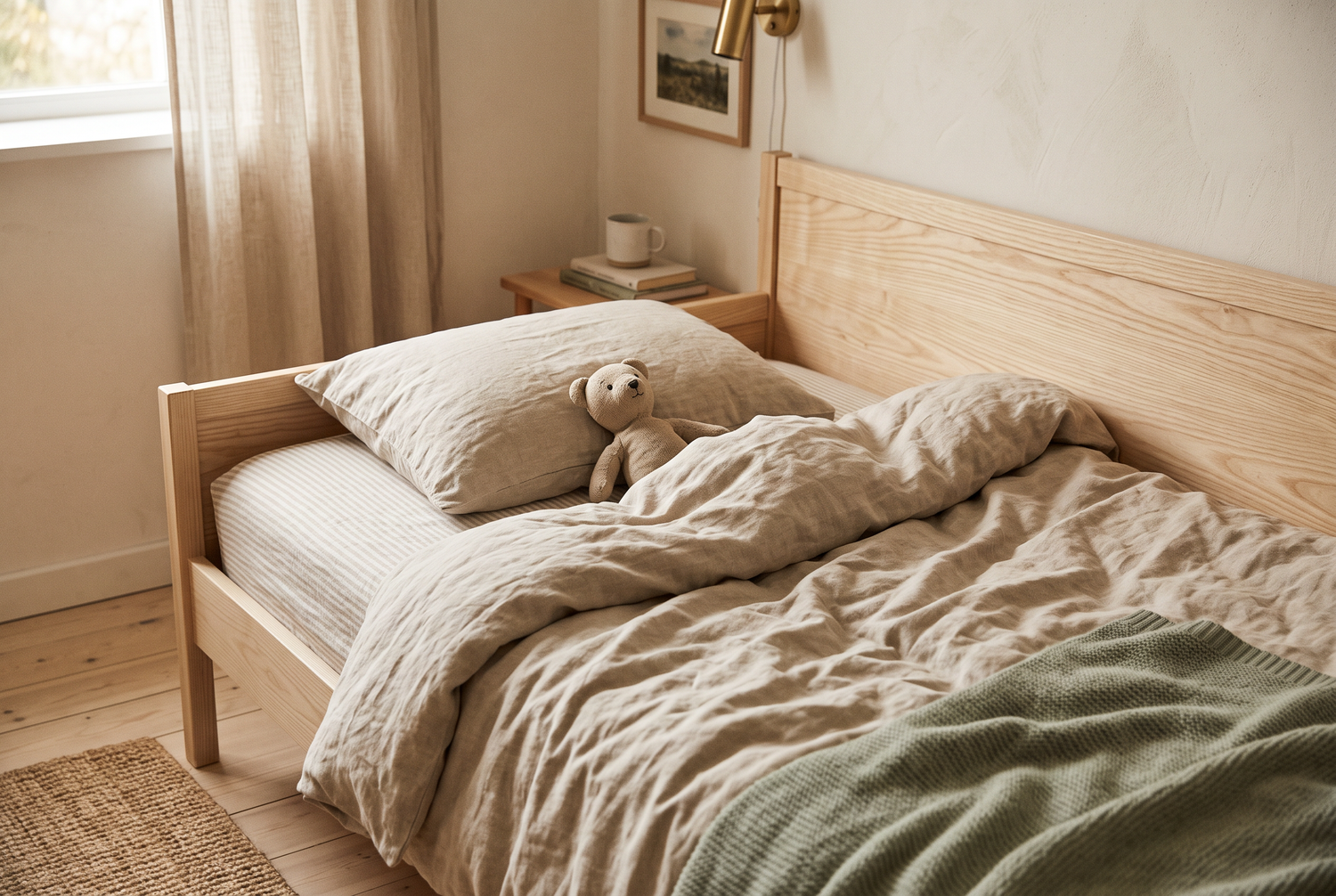
It sounds paradoxical: the more tired a child is, the more awake they seem. Instead of yawning, they get wound up in the evening, run through the apartment, laugh shrilly – and ten minutes later throw a tantrum over the wrong water bottle. Many parents interpret this behavior as “not tired yet” and push bedtime back. This only exacerbates the problem: Overtired children release stress hormones that make it harder to fall asleep and make sleep less restful. This creates a vicious cycle that can build up over weeks – with early waking, night waking, and even more daytime fatigue. The good news: Overtiredness has clear, recognizable signs, and the solution is simpler than you might think. This guide shows which signals are typical at what age, how much sleep children really need, and how to get an overtired child back into a restful rhythm in just a few days.
The short answer: You recognize an overtired child less by yawning than by behavioral changes: being wound up in the evening, shrill laughter that quickly turns into crying, clumsiness, irritability over minor things, eye rubbing and looking away in babies. The most important counter-move is counter-intuitive: bring bedtime forward instead of pushing it back – usually by 30 to 60 minutes – and maintain very consistent, calm evening routines for a few days. After 3 to 7 days of sufficient sleep, the behavior of most children normalizes significantly.
- Overtiredness in children often manifests as being wound up, not tiredness – the body overcomes exhaustion with stress hormones like cortisol.
- Early signals (eye rubbing, looking away, fussiness) are the ideal window – if you miss them, you get the overexcited stage.
- The most common mistake: pushing bedtime back. The correct approach is the opposite – 30 to 60 minutes earlier to bed.
- Recommended total sleep: 1–2 years approx. 11–14 hours, 3–5 years 10–13 hours, 6–12 years 9–12 hours per 24 hours.
- Chronic overtiredness affects mood, concentration, and the immune system – if it persists despite measures, it should be medically evaluated.
Why overtired children get wound up instead of falling asleep
Behind the paradox lies physiology: If the natural sleep window is missed, the child's organism interprets the prolonged wakefulness as a stress situation and mobilizes cortisol and adrenaline. These hormones keep the child awake, increase pulse and muscle tension, and lower frustration tolerance – the child appears wound up. At the same time, the ability to self-regulate decreases: a brain in stress mode has more difficulty inhibiting impulses, which is why tantrums, defiance, and tears occur so reliably when overtired. Falling asleep itself suffers twofold: the high level of arousal delays it by 30 to 60 minutes, and subsequent sleep is more fragmented – overtired children wake up more frequently at night and often even wake up earlier in the morning because stress hormones shorten morning sleep. If you want to understand the cycles in which children's sleep is organized, you can find the basics in the article on sleep phases. Crucial for daily life is a change in perspective: a child who is romping through the apartment at 8 p.m. is rarely too awake for bed – they are usually too tired for it.
Signs by age: how overtiredness manifests
| Age | Early signs | Late signs (overtired) |
|---|---|---|
| Baby (0–12 months) | Looking away, eye rubbing, ear pulling, quiet fussing | Shrill overexcitement, arching back, inconsolable crying |
| Toddler (1–3 years) | Stumbling, thumb sucking, seeking comfort toy, becoming clingy | Hyperactivity, tantrums, refusing to eat, "second wind" |
| Preschool (3–6 years) | Irritability, glazed eyes, waning concentration | Silliness that turns into tears, picking fights, bedtime battles |
| School child (6–12 years) | Difficulty waking in the morning, afternoon energy dip | Mood swings, decline in performance, falling asleep during the day |
The art lies in acting at an early stage: often only 20 to 30 minutes pass between the first signals and becoming overexcited. A fixed "tiredness window" has proven effective: observe your child for a week and note when the early signs appear – that's when, and not later, the evening routine should begin.

How much sleep does my child really need?
Professional organizations recommend the following ranges per 24 hours: infants 4 to 12 months approximately 12 to 16 hours including daytime sleep, toddlers 1 to 2 years 11 to 14 hours, children 3 to 5 years 10 to 13 hours, school children 6 to 12 years 9 to 12 hours, and teenagers 8 to 10 hours. Within these ranges, there are genuine individual differences – what matters is not the number, but the child's condition during the day: A child who wakes up spontaneously in the morning, is balanced during the day, and falls asleep in 15 to 20 minutes in the evening is getting enough sleep. If, however, they only wake up with an alarm, are fussy in the morning, or immediately fall asleep in the car, they are not getting enough sleep – even if the number of hours is "within the range." Calculate backward: If the child has to get up at 7 a.m. and needs 11 hours of sleep, they should be asleep by 8 p.m. – the routine would then start between 7:15 and 7:30 p.m. You can find specific tables with bedtime by wake-up time in the guide Bedtimes for Children by Age.
Breaking the vicious cycle: the 5-day plan
Day 1 to 2: Bring bedtime forward by 45 to 60 minutes. This feels radical but is the fastest way to work – the extra sleep reduces the stress hormone load. Keep the wake-up time constant, even on weekends (±30 minutes). Day 1 to 5: Reduce stimuli. No screens in the 2 hours before bed, calm games from late afternoon, strict and consistent evening routine: dinner, bath or wash, pajamas, 1 to 2 stories, lights out – a total of 30 to 40 minutes. During the day: manage sleep pressure correctly. Toddlers who nap should keep or resume napping, but finish before 2:30 p.m.; for children in transition, a quiet midday break helps – how to do this is described in the article on weaning off naps. Also, at least 60 minutes of outdoor exercise daily – morning daylight sets the internal clock and increases evening sleep pressure. From Day 5 to 7: Fine-tune. If the child falls asleep within 15 minutes in the evening and wakes up rested, the timing is right; if they are awake for 30 minutes, shift bedtime back in 15-minute increments. Important during the transition: remain calm if the child protests – with calm sleep assistance, earlier bedtime succeeds without a power struggle.
Common mistakes when dealing with overtired children
Mistake 1: "They're still active – we'll let them stay up." Being wound up is a late symptom, not the opposite of tiredness. Mistake 2: Exhausting them in the evening. Roughhousing just before bed further increases arousal levels; exercise belongs in the day, the evening belongs to calm. Mistake 3: "Sleeping in" until 9:30 a.m. on weekends. Long lie-ins shift the internal clock and turn Sunday evening into a bedtime drama – it's better to bring bedtime forward than to extend the morning. Mistake 4: Skipping naps so the child is more tired in the evening. During actual overtired phases, this increases the stress state; first stabilize night sleep, then clarify nap issues. Mistake 5: Confusing overtiredness with character. Weeks of irritability, concentration problems, or hyperactivity are quickly attributed to temperament – but many children's behavior normalizes astonishingly once they get enough sleep for a week. Only if sufficient sleep demonstrably doesn't help is it worth looking at other causes – then together with the pediatrician, also to rule out things like snoring, breathing pauses, or iron deficiency.

Get CHF 25 discount
Subscribe to the newsletter and receive a one-time CHF 25 discount. ✓ 200 nights trial sleep ✓ 10 years warranty
Frequent Questions about Overtired Children
Why does my overtired child seem so wound up?
When the sleep window is missed, the body releases cortisol and adrenaline to stay awake. These stress hormones make children restless, irritable, and simultaneously make it harder to fall asleep.
What are the earliest signs of overtiredness?
For babies, rubbing eyes, pulling ears, and looking away; for older children, stumbling, clinginess, a glazed look, and increasing irritability. There are often only 20 to 30 minutes between these signs and becoming overexcited.
Should I put an overtired child to bed later?
No – quite the opposite. Bring bedtime forward by 30 to 60 minutes and keep the wake-up time consistent. Earlier sleep reduces the stress hormone load and also improves night sleep quality.
How quickly does a child recover from overtiredness?
With consistently earlier bedtimes and calm evenings, behavior usually normalizes within 3 to 7 days. Chronic overtiredness over months will take correspondingly longer.
Can overtiredness be confused with ADHD?
The symptoms overlap significantly: restlessness, impulsivity, concentration problems. Before behavioral issues are evaluated, the child should demonstrably get enough sleep for at least one to two weeks – and if questions persist, the pediatrician should be involved.
Does exhausting them in the evening help them fall asleep?
No. Intense roughhousing just before bed increases heart rate and arousal levels and delays falling asleep. Exercise belongs in the day – the last part of the evening in quiet, predictable routines.
This article is for general information only and does not replace medical advice.










Leave a comment
This site is protected by hCaptcha and the hCaptcha Privacy Policy and Terms of Service apply.